When Home is a Tent
A year into the so-called ceasefire and three years into Israel’s assault on Gaza, more than 1.7 million Palestinians remain displaced. Two Gaza residents share what life is like when your home is now a tent
“What you see on television doesn’t represent even one percent of what we live through. Try sitting in a tent and not leaving it, and tell me how you feel — without the bombings and without the drones — just sit in a tent for two days and tell me how you feel.
We, the residents of Gaza, deserve to live. We hope the coming days will be better. We are two million people, dying every day of exhaustion, strain and poverty, and all we ask is to live a simple life, like the rest of the world. It is our children’s right to live like the children of the world, our women’s right to live. It is our right to live. People live in destroyed homes and they collapse on them. No one loves death, but this is a reality that has been forced upon us.”
– “Adnan,” a Gaza resident living with his family in a tent
In the three years that have passed since Hamas’s attack on October 7, 2023, Israel has systematically destroyed the Gaza Strip and upended the lives of every single one of its 2.1 million residents. It damaged or destroyed more than 80 percent of all structures in the Strip, 1,500 kilometers of roads, 94 percent of hospitals, and 97.5 percent of schools. It damaged or rendered inaccessible 97 percent of Gaza’s agricultural lands. It damaged more than 370,000 homes. Of the homes that were damaged, 85 percent were completely destroyed. Significantly, to this day, a year after the so-called ceasefire went into effect, not a single home has been rebuilt.
The killing of more than 74,000 people and the injuring of some 175,000, a quarter of whom are living with life-altering conditions, are the most searing of the crimes committed. Also profound is Israel’s mass displacement of the population, and its crowding of almost all 2.1 residents into less than half the area of the Strip behind the Yellow Line. The sheer extent of destruction and ongoing restrictions on humanitarian services and entry of aid mean that people are living in harrowing conditions without adequate shelter, sanitation, and healthcare and with no prospect of change on the horizon.
Home is not just the physical structure that comprises one’s house, it is the possibility of refuge, personal space, a place to gather with family, and protection from the elements. It is capital, inheritance, a spot on the earth that one can claim as one’s own.
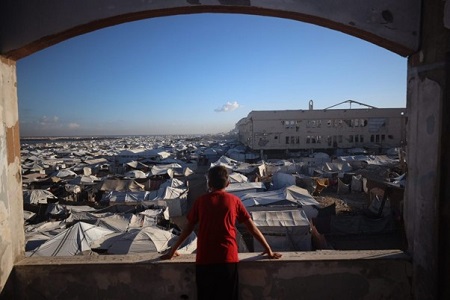
Most of the Strip’s residents were displaced during the war, the majority of them more than once and many of them multiple times. They took what they could with them, and where they landed, they made the most with what they had. As of September 2026, 1.7 million are still living in displacement – in tents and other makeshift shelters, schools, and bombed out buildings.
A report on the costs of displacement by the Danish Refugee Council (DRC) and the Palestinian Agricultural Development Association (PARC) summarizes: “Protracted displacement means living with a specific set of daily conditions. People carry water by hand over long distances. Tents are shared by more people than they were built for. Rodents enter bedding and attack residents, especially children, at night.”
The crowded conditions in which people are living, combined with a sense of helplessness to change one’s reality, are contributing to deep psychological distress, a rise in domestic violence and family disputes, all of which impact women, children, and other vulnerable populations disproportionately.
Simple, daily tasks that were once taken for granted are now substantially more challenging, such as obtaining clean water, cooking, bathing, and using the bathroom, particularly for people living with disabilities. As of September 2025, 42,000 people had experienced , including traumatic brain and spinal injuries. More than 5,000 limb amputations had occurred, making mobility in dusty tent encampments or in shelled out buildings all the more complicated.
To mark three years of this reality, Gisha interviewed two individuals living in tent encampments in Gaza. Dallal (a pseudonym), a mother of six, lost her eldest son who was run over while trying to obtain aid. She is the family’s main breadwinner; her partner lives with a complex physical disability. Adnan (a pseudonym) is married and a father of four. One child has a disability and uses a wheelchair. The family of six lives in a tent. Before the war, Adnan worked in Israel to support his family.
(See interview excerpts in the original article)
Photo: A Palestinian child looks over a displaced persons tent encampment in Gaza City. Source: Majdi Fathi.